
- About the TecnoCampus
- Where we are and contact information
- Undergraduate students
- eCampus degrees
- Timetables and calendars
- Future undergraduate student
- TecnoCampus Facilities
- University activities
- CRAI Library
- Continuing education students
- eCampus official masters
- eCampus diplomas and postgraduate degrees
- Future lifelong learning student
- HUB4T - Continuing Education Center
- University center
- Alumni
- Teaching staff
- Service for Quality and Teaching Innovation
- TecnoCampus quality
- Corporate information
- Communication and press room
- TecnoCampus corporate image
- Events
- Transparency portal
- Equality and Diversity Unit
- Supplier's office
- Work with us
- Entrepreneur support services
- Tools for entrepreneurs
- Aid for business creation
- Creatic Awards
- Reimagine Textile Program
- Trenlab Antenna Program
- Services for business growth
- Acceleration
- Financing
- Internationalization
- TecnoCampus Park
- Spaces to set up a company
- Park business directory
- Congress centre
- Upcoming events
- Sectoral programs
- Textile cluster
- Health cluster
- Trenlab Antenna
- Additive manufacturing and 3D printing
- Circular economy
- Sustainable business
What are you looking for?
A study identifies differences in the risk of mortality during heat waves in dependent people according to the care environment
July 03, 2026
The study, presented at the XLV Health Economics Conference held at the University of Seville, analyzes more than 182.000 cases of elderly people with dependency in Catalonia and provides new evidence to guide long-term care policies in the face of climate change.
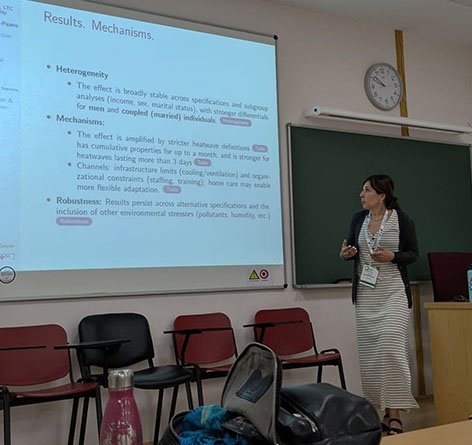 Helena M. Hernández-Pizarro during the presentation of the study on heat waves and dependency
Researchers from the GRAEFES research group at TecnoCampus and the CRES UPF research group Helena M. Hernández-Pizarro and Albert Prades-Colomé have presented the paper Too Hot to Cope? The Role of Long-Term Care Against Heatwave Health Risks within the framework of the XLV Conference on Health Economics (AES), held from June 17 to 19 at the University of Seville under the motto “Data, evidence, decisions: generating value for health management and policies".
This congress is one of the leading scientific meetings in Spain in the field of health economics and brings together researchers, healthcare professionals, managers and public policy makers to debate the main challenges of health systems.
The study analyzes how the environment where long-term care is provided (care for dependency) influences the risk of mortality associated with heat waves among older people with dependency needs, an issue of great relevance given the increase in the frequency and intensity of extreme heat episodes resulting from climate change. The research uses administrative data from more than 182.000 people over 60 years of age with level II or III dependency in Catalonia, corresponding to the period 2015-2024, combined with meteorological and environmental information.
Using advanced econometric techniques, researchers estimate the causal effect of the type of care received—residential care or care in the home environment—on mortality during heat waves. The results indicate that, compared to home care, people in residential centers have a significantly higher increase in mortality during episodes of extreme heat and the days immediately following. The study suggests that this effect could be related to limitations in the air conditioning of the facilities, the characteristics of the buildings or certain organizational factors, such as the availability of personnel and specific training in situations of extreme heat.
Based on these results, the researchers highlight the need to incorporate adaptation to climate change into dependency care policies, reinforcing measures such as improving cooling and ventilation systems, protocols for dealing with heat waves and training professionals, both in the residential and home care sectors.
TecnoCampus' participation in this international congress contributes to strengthening the visibility of the research carried out at the institution in the areas of health economics, aging and public policies, and highlights the generation of scientific evidence to address the effects of climate change on the health of the most vulnerable population.
This research is also part of the industrial doctorate that Albert Prades-Colomé is developing, in collaboration with the Department of Social Rights and Inclusion of the Generalitat de Catalunya, a project funded by the Agency for the Management of University and Research Grants (AGAUR), which promotes the transfer of knowledge between the university and the public administration.
Institution
Study
Become an entrepreneur

TecnoCampus
Tel. +34 93 169 65 00
info@tecnocampus.cat
Av. Ernest Lluch, 32 | 08302 Mataró
© 2026 TecnoCampus. All rights reserved.
Web project developed by ACTIUM Digital