
- About the TecnoCampus
- Where we are and contact information
- Undergraduate students
- eCampus degrees
- Timetables and calendars
- Future undergraduate student
- TecnoCampus Facilities
- University activities
- CRAI Library
- Continuing education students
- eCampus official masters
- eCampus diplomas and postgraduate degrees
- Future lifelong learning student
- HUB4T - Continuing Education Center
- University center
- Alumni
- Teaching staff
- Service for Quality and Teaching Innovation
- TecnoCampus quality
- Corporate information
- Communication and press room
- TecnoCampus corporate image
- Events
- Transparency portal
- Equality and Diversity Unit
- Supplier's office
- Work with us
- Entrepreneur support services
- Tools for entrepreneurs
- Aid for business creation
- Creatic Awards
- Reimagine Textile Program
- Trenlab Antenna Program
- Services for business growth
- Acceleration
- Financing
- Internationalization
- TecnoCampus Park
- Spaces to set up a company
- Park business directory
- Congress centre
- Upcoming events
- Sectoral programs
- Textile cluster
- Health cluster
- Trenlab Antenna
- Additive manufacturing and 3D printing
- Circular economy
- Sustainable business
What are you looking for?
Guillermo Antuña presents research on the limits of European steel policy at the World Congress of Business History
14 September 2026
Guillermo Antuña, professor in the Department of Business at TecnoCampus, has presented the work in progress “From Liberalization to De-risking: The Limits of European Steel Policy” at the 3rd World Congress of Business History, held at the University of Toronto. The research, developed jointly with Angela Wigger, professor of Global Political Economy in the Department of Political Science at Radboud University, analyzes from a historical perspective the capabilities and limits of current European steel policy.
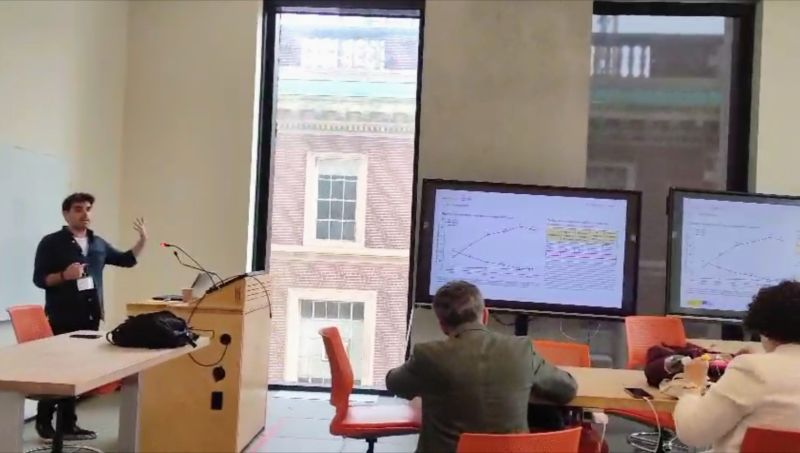 Professor Guillermo Antuña, during the intervention at the World Congress of Business History
The work studies how the transformation of European public policies since the stage of the European Coal and Steel Community (ECSC) has conditioned the current capacity for intervention in the sector.
If during the ECSC public authorities combined productive coordination, financial support, management of foreign markets and social policies, subsequent liberalisation dispersed these capacities between different instruments and policies, while privatisation and business concentration reinforced the control of large groups over production and investment.
The main implication of the research is that current European reindustrialization and decarbonization policies operate on this inherited institutional structure. European institutions have the capacity to authorize public aid, assume part of the financial and social risks, protect the European market or stimulate demand for low-carbon steel, but they have a much more limited capacity to coordinate productive investments and ensure that announced projects are executed.
In this context, large multinational steel groups play a decisive role in final investment and production decisions.
Institution
Study
Become an entrepreneur

TecnoCampus
Tel. +34 93 169 65 00
info@tecnocampus.cat
Av. Ernest Lluch, 32 | 08302 Mataró
© 2026 TecnoCampus. All rights reserved.
Web project developed by ACTIUM Digital